
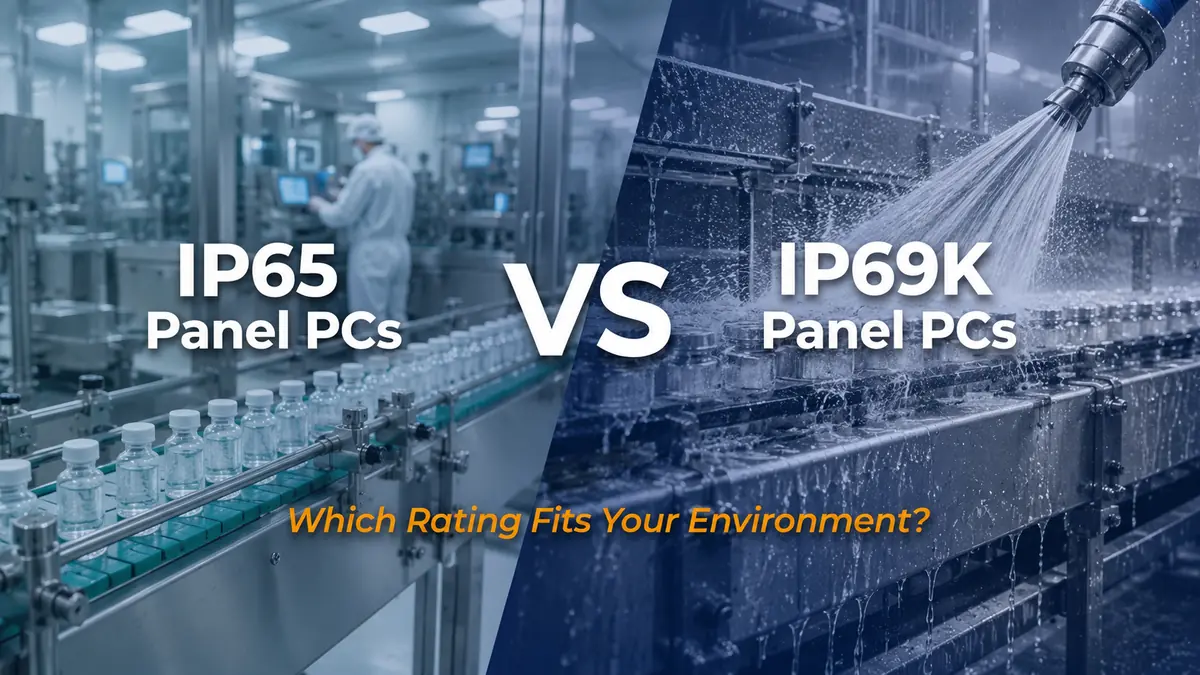

The IP69K vs IP65 panel PC choice usually gets made from the industry the plant is in, rather than from what the unit will actually be sprayed with. A pharmaceutical cleanroom and a poultry plant are both hygienic environments, and they need opposite things. IP65 is often enough for dust, wiping, splashing and routine water jets, where there is no aggressive sanitation. IP69K is for a unit that has to take close-range, high-pressure, high-temperature washdown. Either way, the rating is only half the specification. Check whether it covers the whole enclosure or only the front, and check connectors, cleaning chemicals, corrosion, immersion and condensation separately.
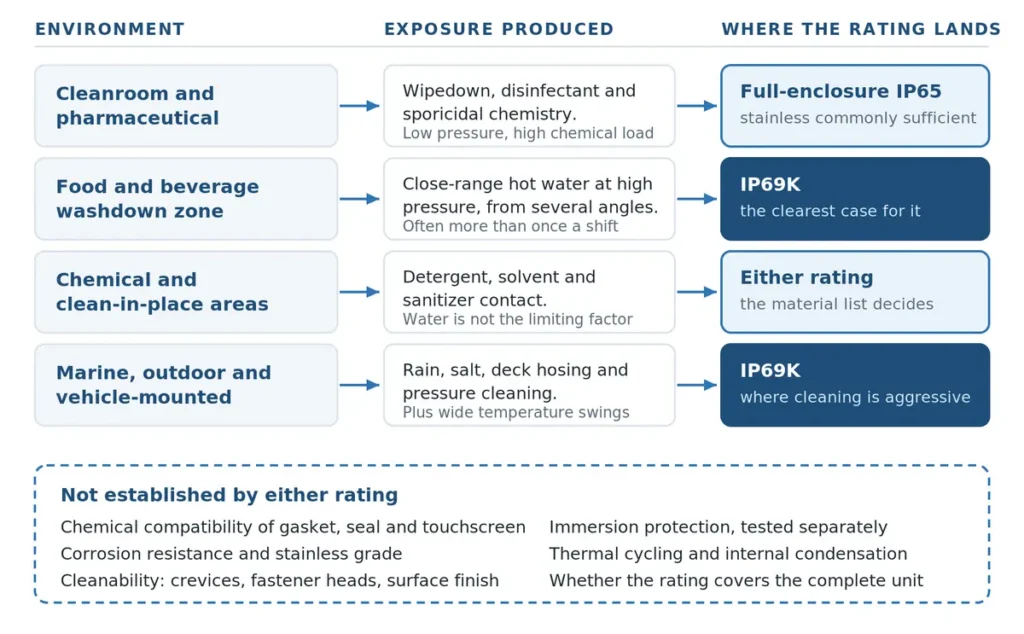
IP69K vs IP65 panel PC selection by cleanroom, washdown, chemical and outdoor exposure.
Figure 1. The rating follows the exposure, not the industry. The band along the bottom is what neither rating establishes on its own.
What the second digit changes, and what it does not
Dust is not the variable: both ratings sit at the top of the solid-object scale. The IEC’s ingress protection ratings put the second numeral on a scale from 0, meaning no protection, to 9, which the IEC describes as high-pressure hot water from different angles. The IEC treats its own summary as informational and points to IEC 60529 for the test conditions, which is where nozzle distance, flow rate, pressure and water temperature are defined.
The K is not part of the IEC’s two-numeral code. IP69K is commonly referenced instead to ISO 20653, the road-vehicle IP code, whose current published edition is ISO 20653:2023; IP69 is used separately inside the IEC framework. Suppliers do not apply the two consistently, so the useful question at quotation is not whether a product is IP69K but which standard and test method the claim rests on, and whether the tested article was the complete configured unit.
Four environments, four different reasons the answer changes
Food and beverage washdown
This is where the second digit does real work: hot water at high pressure, delivered close to the equipment, from several angles, often more than once a shift. Caustic and acid cycles usually bracket the rinse, and no ingress test speaks to those at all.
In a US plant covered by them, the FDA’s current good manufacturing practice requirements for human food state that equipment in areas where food is manufactured, processed, packed or held, and that does not come into contact with food, “must be so constructed that it can be kept in a clean and sanitary condition.” A panel PC bolted to a packaging line is exactly that equipment. Surviving the spray and being cleanable are two different properties, and only one of them is an IP test.
Cleanroom and pharmaceutical
Here the pressure is usually low and the chemistry is aggressive, which inverts the usual assumption. EU GMP Annex 1 states that in cleanrooms and critical zones, all exposed surfaces should be smooth, impervious and unbroken in order to minimize the shedding or accumulation of particles or micro-organisms. It also states that materials used in cleanrooms, both in the construction of the room and for items used within the room, should be selected to minimize particle generation and permit the repeated application of cleaning, disinfectant and sporicidal agents where used. Both are advisory in the original wording, and the guideline is European.
Read as an enclosure specification, that describes a stainless housing with no crevices, no exposed fastener heads and a bezel that seals flush, whose gasket, surface finish and touchscreen take repeated sporicidal application for years. None of it describes a water jet. Therefore, a cleanroom can justify a fully sealed stainless panel PC while never producing more water than a wipedown: a common case for a full-enclosure IP65 product rather than IP69K.
Chemical and clean-in-place process areas
IP tests use water. Nothing in either rating speaks to what a quaternary ammonium sanitizer does to a gasket over two years, or peracetic acid to a bezel edge, or a solvent mist to a touchscreen’s optical bonding.
The limiting component here is usually a seal or surface finish rather than the enclosure, so the specification that matters is a material list: gasket compound, enclosure and fastener grade, touchscreen surface and cable jacket, checked against the chemistry in use at its actual concentration and contact time.
Marine, outdoor and vehicle-mounted
ISO 20653’s road-vehicle scope is directly relevant here. Deck hosing, driving rain, road spray and pressure cleaning of mobile equipment all point up the scale. These ratings still leave two things open.
Corrosion: A rating describes ingress, not what salt does to a housing or fastener over a season. The stainless grade is a separate line item.
Immersion: The ninth level is defined by jets from different angles, and immersion is a separate test. A jet rating is not by itself an immersion rating.
Thermal cycling belongs in the same group. An enclosure sealed well enough to keep water out also keeps moisture in. Equipment that goes from a cold night to a hot afternoon behind glass can condense internally, whatever its rating says, unless the design accounts for it.
IP69K vs IP65 panel PCs side by side
| Specification | IP65 panel PC | IP69K panel PC |
|---|---|---|
| First digit | Dust-tight | Dust-tight |
| Second digit | Water jets | High-pressure, high-temperature water jets from multiple angles |
| Reference test | Defined in IEC 60529 | Commonly referenced to ISO 20653, and also used as IP69 within the IEC framework |
| Typical cleaning | Wiping, splashing, rinsing and lower-pressure jets | Close-range sanitation at elevated pressure and temperature |
| Typical enclosure | Aluminum, coated metal or stainless steel | Frequently stainless steel |
| Typical placement | General industrial areas, cleanrooms, control cabinets and areas outside the washdown zone | Inside the direct washdown or sanitation zone |
| Relative cost | Usually lower | Usually higher |
| What the rating does not establish by itself | Chemical compatibility, corrosion resistance, immersion protection, thermal cycling, condensation and surface cleanability | Chemical compatibility, corrosion resistance, immersion protection, thermal cycling, condensation and surface cleanability |
Where the rating stops
The last row of that table is where the surprises come from. Five things need to be settled separately from the number.
Whether the rating covers the whole product
This is the most common misunderstanding we see. Many panel-mount computers state a front-surface rating that applies once the unit is installed in a compatible cutout, while the rear housing, connectors and cables carry a lower rating.
That is a legitimate specification for a machine front, but it is not the same product as a fully sealed enclosure. Most standard panel PCs are front-rated, including ours; our stainless range is rated as a complete enclosure. Ask which of the two you are being quoted, in writing on the quotation rather than relying only on the brochure.
The connectors, not only the housing
An enclosure is only as sealed as its weakest penetration. Power, Ethernet, USB, serial and I/O entries, their glands and caps, and the mating cables all carry their own ratings. The lowest rating in the chain is what the installed assembly is worth. An unused port closed with a plastic dust cap is a rated enclosure on paper only.
Corrosion resistance and stainless grade
Ask which stainless grade and surface finish are being supplied. A smooth, low-crevice surface gives water, chemicals and sanitation residue fewer places to collect.
How operators will use the touchscreen
Projected capacitive touch provides the interface people expect, but it can respond unpredictably to standing water or heavy wet gloves. Resistive touch supports gloves and deliberate single-point input without the same gesture behavior.
Neither technology is universally better. They behave differently once water or gloves are involved, and sanitation crews and line operators may want different things from the same screen.
How the panel PC is mounted
An arm-mounted unit that routes cabling internally through the support arm takes exposed connections out of the wash zone. A wall or VESA mount with a cable loom hanging behind it does not, whatever the enclosure is rated. Review the installed assembly, not only the display surface.
When IP69K is not the answer
Specifying up is not free, and the higher rating is not automatically the safer choice. An IP65 panel PC is usually sufficient when the unit sits outside the direct washdown zone, when cleaning involves wiping, splashing or light rinsing, when the machine front is exposed but the rear enclosure is inside a cabinet, or when dust and incidental moisture are the real concerns.
Control cabinets, packaging machinery, CNC and laser cutting equipment, machine vision stations, warehouse and logistics terminals, and building automation systems can all sit comfortably in this category. So can the cleanroom case above, where stainless construction and chemical tolerance carry the requirement but the high-pressure spray never arrives.
Where NODKA fits
NODKA builds panel PCs on both sides of this decision, so the choice is between products rather than between suppliers. The standard multi-touch panel PC and resistive touch panel PC series are front-rated IP65 for panel-mount installation, which is the right specification when the machine front is the only exposed surface.
Where the entire unit is exposed to the environment, the stainless range is rated as a complete enclosure. The WP2151-H-C provides full-enclosure IP65 protection. Its arm-mount adapter routes cabling internally through the support arm, taking exposed connections out of the wash area altogether.
For direct washdown zones, NODKA offers the full-enclosure IP69K WPXXX3-C, WPXXX1T-C and WPXXX1T-R1 series.
Front-rated vs full-enclosure panel PC showing the IP-rated boundary around the bezel, housing and connectors.
Figure 2. Front-rated and full-enclosure products can quote a similar number. The rated boundary is what differs, and connectors and cable entries are where it usually ends.
NODKA waterproof panel PC options
| Series | Protection | Sizes and touch | Suited to |
|---|---|---|---|
| TPC6000 multi-touch and resistive touch series | Front IP65, panel mount | 10.4 to 23.8 in., capacitive or resistive | Machine fronts where only the bezel is exposed |
| WP2151-H-C | Full-enclosure IP65 | 21.5 in. capacitive, arm mount with internal cable routing | Hygienic and cleanroom HMIs, MES and traceability stations outside the spray zone |
| WPXXX3-C | Full-enclosure IP69K | 15.6, 21.5 and 23.8 in. FHD capacitive | Direct washdown installations needing current processor options |
| WPXXX1T-C | Full-enclosure IP69K | 15, 19 and 21.5 in. capacitive | Multi-touch operation inside sanitation zones |
| WPXXX1T-R1 | Full-enclosure IP69K | 15, 19 and 21.5 in. resistive | Gloved or deliberate single-point operation |
Across the stainless series, processor options run from Intel Processor N97 and Celeron J1900 or J6412 up to Core i3 and i5, with dual Gigabit Ethernet, two serial ports, two USB ports and DC 12 to 24 V input throughout.
Where a build needs a different processor, I/O set, mounting method or branding, NODKA’s OEM/ODM engineering services can configure it rather than forcing the application onto a catalog part.
Key takeaways
- Specify from the exposure the enclosure will see, not from the industry name on the site. A cleanroom and a poultry plant are both hygienic environments and pull in opposite directions.
- Cleanrooms often need the enclosure properties of a washdown product without the high-pressure water, so a full-enclosure IP65 stainless product is frequently the right answer.
- Neither IP65 nor IP69K establishes chemical compatibility, corrosion resistance, immersion protection or condensation performance. Those requirements must be settled separately using the complete material and system specification.
Frequently asked questions
Is an IP65 panel PC waterproof?
IP65 means dust-tight and protected against water jets under a defined test. It says nothing about immersion, every combination of pressure, temperature and duration, or exposure to chemicals. “Waterproof” is a marketing word; the rating is a test result.
Can an IP65 panel PC be used in food processing?
Often, yes, depending on where it sits and how the area is cleaned. Outside the direct washdown zone, or where sanitation involves wiping and light rinsing, a full-enclosure IP65 stainless unit is frequently appropriate. Inside a zone that receives close-range, high-temperature and high-pressure spray, IP69K is the safer specification.
Is IP69K suitable for a cleanroom?
It is usually more than the water exposure requires, and specifying up is not free. What matters in a cleanroom is the sealed, smooth, low-crevice stainless housing and its tolerance of repeated disinfectant and sporicidal application. A full-enclosure IP65 stainless product can provide those properties at a lower cost.
Are IP69 and IP69K the same?
They are closely related and are not always used consistently. IP69 appears within the IEC framework, while IP69K is commonly referenced to ISO 20653, whose scope is electrical equipment for road vehicles. Ask which standard and test method a specific claim rests on.
Does an IP69K rating cover chemical resistance?
No. Ingress testing uses water. Compatibility with detergents, sanitizers, solvents and process chemicals must be assessed against the enclosure, gasket, seal and touchscreen materials at the concentration and contact time used in the facility.
Does the rating apply to the entire panel PC?
Not always. Some products are rated on the front surface only when correctly panel-mounted, with a lower rating on the rear housing, connectors and cables. Others are rated as a complete sealed enclosure. Confirm which configuration is being quoted. NODKA’s standard panel PC series are front-rated IP65, while the stainless waterproof range is rated as a complete enclosure.
Specify the Right Waterproof Panel PC
Compare front-rated and full-enclosure panel PCs for hygienic, washdown, cleanroom, and outdoor installations.