

Does Every AI-Powered Machine Vision System Need a Discrete GPU?
Article Key Points:
- Not every AI-powered machine vision system needs a discrete GPU; many inspection nodes can run effectively on a well-matched industrial PC.
- Factory-scale deployments change the hardware decision from peak performance at one station to rollout efficiency across many nodes.
- Discrete GPUs still make sense for the most demanding workloads, such as high-resolution, high-throughput, multi-camera, and GPU-first AI inspection cells.
- Many practical vision tasks like barcode reading, OCR/OCV, visual verification, and defect classification often do not require discrete GPU-class performance.
- Integrated edge AI platforms, including Intel Core Ultra-based systems, can support moderate AI vision workloads while reducing power, thermal, and deployment complexity.
- The best machine vision hardware strategy is to match compute to the actual workload so systems are easier to standardize, scale, service, and maintain over time.
As AI-powered machine vision moves deeper into smart factory design, one assumption still shows up in many projects: every vision node must have a discrete GPU.
That is not always true.
For the most demanding inspection cells, a discrete GPU still makes sense. But many AI-powered machine vision deployments are not built around one flagship system. They are built around dozens or even hundreds of inspection points spread across lines, cells, and stations. In those environments, system architects have to think beyond peak AI throughput. They also have to consider power, thermals, enclosure size, lifecycle stability, rollout cost, and long-term serviceability.
In many projects, the practical decision comes down to which vision nodes truly need discrete GPU performance and which can run on a more efficient IPC configuration.
For many barcode, OCR and OCV, visual verification, defect classification, and moderate AI inspection tasks, an IPC configuration can be the more practical platform when the workload, frame rate, and software stack do not require discrete GPU-class throughput. The question is not whether acceleration matters. It does. The question is where discrete GPU performance truly belongs, and where a more integrated platform is the better fit.
Why Factory Scale Changes the AI Machine Vision Hardware Decision
A single high-performance inspection station can justify a very different hardware design than a rollout across an entire factory. When AI-powered machine vision expands from a few specialized cells to a larger network of distributed nodes, the hardware decision stops being only about the capability of one node.
At factory scale, the decision becomes architectural: how many nodes will be installed, which ones truly need discrete GPU-class acceleration, and how the overall system will be standardized, deployed, serviced, and maintained across the floor.
What a Discrete GPU Still Does Best
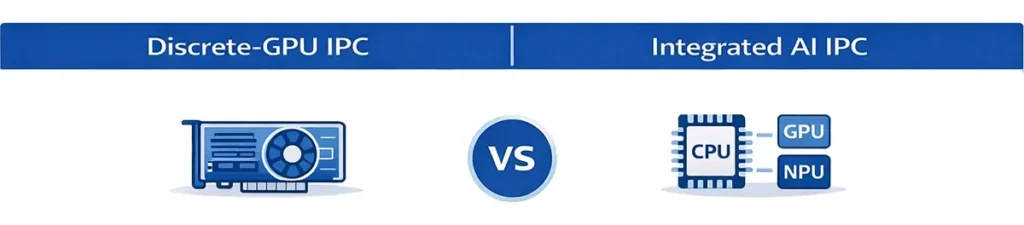
A balanced machine vision strategy starts by recognizing where a discrete GPU still delivers clear value. Discrete GPUs remain the right fit for the most imaging- or AI-compute-intensive workloads, especially where inspection speed, image resolution, model size, batching, or multi-stream processing push well beyond what an integrated platform can handle comfortably.
Typical examples include:
| When a Discrete GPU Makes Sense | Why It Matters |
|---|---|
| High-resolution, high-throughput inspection | Large image sizes and rapid line speeds can demand more parallel compute |
| Multi-camera AI inspection cells | Several concurrent streams may benefit from larger dedicated graphics memory and higher throughput |
| Larger-model or higher-throughput deep-learning workloads | Bigger models, heavier inference pipelines, or more aggressive throughput targets can exceed the practical range of integrated platforms |
| Specialized software stacks built around GPU-first deployment | Some deployments are already tied to mature CUDA- or TensorRT-based workflows |
| Advanced edge AI cells | Premium stations can justify higher cost, higher power, and more complex cooling if the application requires it |
Which AI-Powered Vision Nodes Often Do Not Need a Discrete GPU
The deeper a rollout goes into real production, the more often the workload becomes practical rather than extreme. Many AI-powered factory vision tasks are still built around structured edge applications such as barcode and QR code reading, OCR and OCV, label presence and placement checks, visual verification, assembly confirmation, defect classification on known patterns, and traceability logging.
These are still important AI-enabled or vision-enabled tasks, but they do not always justify a discrete GPU in every station. In many cases, the inspection scene is constrained enough that the practical challenge is deployment scale, not maximum parallel compute. That is where an IPC without a discrete GPU becomes a more practical option for the parts of the rollout that do not need that level of compute.
How Integrated Edge AI Platforms Change AI Machine Vision Node Design
Industrial PCs are not tied to one processor or accelerator strategy. The right choice still depends on workload, software stack, thermals, form factor, and rollout strategy. What is changing is that a newer generation of integrated edge AI platforms is making more AI-capable vision nodes possible without assuming a discrete GPU is required from the start. These designs combine CPU resources with integrated graphics and, in some cases, dedicated AI acceleration in one compact system. That is most relevant for moderate edge inference and mixed machine-vision workloads, not as a blanket replacement for the heaviest GPU-first cells.
Intel® Core™ Ultra-based systems are becoming increasingly relevant in this part of the market because they bring more heterogeneous compute resources into one compact industrial platform. For OEM teams and system integrators, this matters in practical ways when the goal is to scale AI-powered inspection without defaulting to a discrete GPU in every node:
| Integrated Edge AI Platform Characteristic | Why It Matters in Machine Vision System Design |
|---|---|
| Integrated CPU, GPU, and NPU resources | Supports a broader range of AI and vision workloads in one compact platform |
| Lower power and thermal burden than a discrete GPU node | Helps simplify enclosure, cooling, and cabinet design |
| Compact industrial deployment | Makes machine-level, cabinet-level, and distributed edge installation easier |
| Better fit for scale-out architectures | Helps control cost when many nodes must be deployed across a facility |
| Stronger edge computing story | Supports local processing near cameras, machines, and automation systems |
How Scale Changes the Hardware Cost Equation
A useful way to think about this is through a multi-camera AI inspection rollout across a smart factory. Once the number of systems grows, the economic side of the architecture becomes much harder to ignore. A project with many distributed inspection nodes has to account for per-node hardware cost, power draw, cooling requirements, network separation, lifecycle consistency, and maintenance overhead. That is why the decision is often not between “weak hardware” and “strong hardware.” It is between performance-matched hardware at scale and overbuilding every node.
What Matters Beyond Raw AI Performance in Machine Vision
In real factory deployments, TOPS alone rarely decides the hardware choice for an AI-powered machine vision node. A more practical evaluation should include performance for the target inspection task, number of cameras and image streams, power and thermal constraints, enclosure and mounting limits, I/O and automation integration needs, lifecycle expectations, and manageability over time.
A node that is technically impressive but expensive, power-hungry, and difficult to standardize may not be the best choice once the machine vision rollout grows. In many deployments, the more effective strategy is to use a small number of IPC roles across the architecture rather than forcing every vision node into the same hardware profile. Some nodes may be better suited to compact machine-level deployment, while others may justify a more centralized or higher-performance configuration.
What This Means for OEM and System Integration Teams
For OEM teams, the main question is not whether a discrete GPU is good. It is whether a discrete GPU is necessary across the architecture they are trying to standardize. For system integrators, the value often comes from matching the hardware to the inspection workload instead of assuming every node should be built around the most powerful option available.
That approach supports more repeatable rollout planning, better control over bill of materials, easier cabinet and machine integration, lower thermal and power overhead at scale, and more practical long-term lifecycle management. In other words, choosing the right AI-powered machine vision platform is not only an AI decision. It is a system design and rollout decision.
Conclusion
No, not every AI-powered machine vision system needs a discrete GPU.
Discrete GPUs still make sense for the most demanding inspection cells, and they should remain part of the design conversation where throughput, model size, multi-stream demand, or software requirements justify them.
But for many distributed AI-powered machine vision deployments, especially across many stations, the more practical choice is often an IPC architecture that reserves discrete GPU hardware for the nodes that truly need it. Intel® Core™ Ultra-based platforms strengthen that option for some deployments by combining CPU, GPU, and NPU resources in a more deployment-friendly design.
For OEM and system integration teams, the real goal is not just building a machine vision system that works. It is building one that can