

Industrial control is becoming more software-defined. Traditional PLCs remain essential, but their runtime, engineering environment, and hardware are usually delivered as one vendor-managed system. A soft PLC, or PC-based PLC, separates those layers by running the control runtime as software on an industrial computer.
OpenPLC is one visible example. Its open-source editor creates IEC 61131-3 projects for a runtime that can execute on platforms ranging from single-board computers to x86 and ARM industrial PCs. That portability does not make the runtime unimportant. It makes the hardware, operating system, I/O architecture, and lifecycle separate design decisions. This article maps the soft PLC landscape, looks at where the trend is heading, and explains what changes when PC-based control moves from a prototype to a production machine.
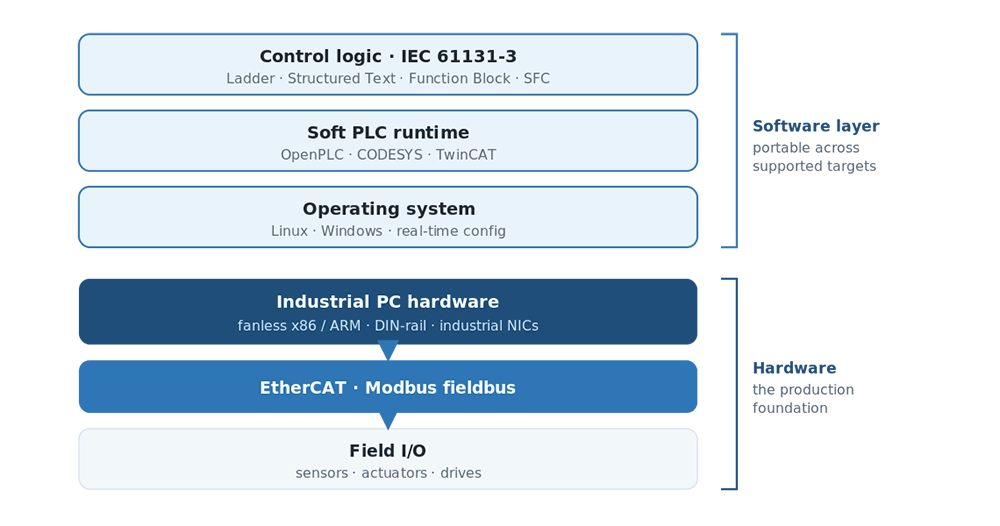
Figure 1. A soft PLC decouples control software from a fixed controller platform. Portability increases hardware choice, but production performance still depends on the runtime, operating system, industrial PC, network, and I/O architecture working together.
What is a soft PLC (PC-based PLC)?
A soft PLC is a PLC runtime installed on a general-purpose computing platform rather than supplied only as part of a fixed, vendor-specific controller. Depending on the control stack, it can run on an x86 or ARM industrial PC under Linux or Windows, often with real-time scheduling, a real-time kernel, or a runtime extension.
The programming model remains familiar. Soft PLC platforms commonly support IEC 61131-3 languages such as Ladder Diagram, Structured Text, Function Block Diagram, Sequential Function Chart, and legacy Instruction List.
The attraction is flexibility: easier connectivity between control and IT systems, room for HMI and edge applications on the same computing platform, more hardware choice, and the option to consolidate workloads where the architecture allows it. Established platforms such as CODESYS and Beckhoff TwinCAT have demonstrated PC-based control at industrial scale, while open-source projects such as OpenPLC are making the model more accessible.
This is not a simple replacement story. Dedicated PLCs remain a strong choice for many fixed, validated, and safety-certified applications. PC-based systems can also meet demanding real-time and safety requirements, but only when the runtime, operating system, hardware, I/O, and certified safety architecture are engineered for them. Hybrid designs are also common: a dedicated safety or low-level controller can coexist with an industrial PC handling higher-level control, visualization, connectivity, or analytics.
Soft PLC and virtual PLC are related, but not identical
A soft PLC is a software-based control runtime running on general-purpose computing hardware. A virtual PLC, or vPLC, usually refers to an isolated software instance, often containerized or virtualized, that can be deployed and managed independently, and in some architectures can share a physical host with other controller instances.
OpenPLC: an open-source signal of the trend
OpenPLC is an open-source PLC software suite that supports IEC 61131-3 programming and can run on hardware ranging from accessible development boards to industrial Linux computers. Its importance is not that every project will choose one runtime. It is that control software can increasingly be portable, inspectable, and separated from the hardware beneath it.
The runtime decision still matters. Language support, real-time behavior, industrial protocol support, cybersecurity, maintenance, certification, licensing, and technical support all vary by platform. The shift is that hardware becomes a first-class and more independent decision alongside the runtime and I/O architecture, not a secondary box chosen after the software.
Where the trend is heading: software-defined control
One of the clearest articulations of this direction comes from Autonomy, the company behind OpenPLC. Its Autonomy Edge platform applies software-development practices to industrial control: projects are Git-backed, with commits, branches, change review, and version history; programs are deployed as containerized virtual PLCs to Linux edge devices; and those devices can be managed as a fleet while control continues to execute at the edge.
In Momenta’s January 21, 2026 investment announcement, Autonomy founder and CEO Thiago Alves framed the goal as redesigning how control software is built and governed, rather than merely moving PLCs into the cloud. That is one company’s product vision, not a settled outcome for the entire control market. It is nevertheless a useful signal of the broader move toward versioned, portable, and software-defined control.
From prototype to production: choosing OpenPLC hardware
Because the software is portable, similar control logic can run on very different hardware. Accessible single-board computers such as the Raspberry Pi are useful for learning, experimentation, and proof-of-concept work. A production machine adds requirements that a workbench does not.
| Consideration | Lab / Development Bench | Production / Plant Floor |
|---|---|---|
| Timing | Best-effort response may be acceptable for functional testing. | Scan time and jitter targets must be validated under worst-case load. Real-time scheduling or extensions may be required. |
| Power | USB or desktop supply. | Protected 24 VDC input, with ride-through or orderly shutdown where required. |
| Environment | Room temperature and light-duty use. | Defined thermal limits, EMC, shock, vibration, humidity, and cabinet conditions. |
| Field I/O | Breadboard, GPIO, or simple remote I/O. | Industrial I/O with the required electrical protection and isolation, plus validated EtherCAT or Modbus integration. |
| Networking | A shared general-purpose network interface. | Industrial NICs and network separation, including a dedicated NIC for EtherCAT where required by the runtime. |
| Mounting | Open board or desktop enclosure. | DIN-rail or cabinet-ready enclosure with serviceable wiring. |
| Lifecycle | Whatever hardware is readily available. | Controlled revisions, documented substitutions, a spare-parts strategy, and an end-of-life plan. |
| Safety | Usually outside the prototype scope. | Risk assessment and a certified safety architecture where required by the application. |
Production readiness is a property of the complete system, not the enclosure alone. The industrial PC provides the foundation: power protection, thermal design, reliable storage, industrial networking, mechanical mounting, environmental qualification, and lifecycle control. The runtime and operating-system configuration determine scheduling behavior and protocol execution, while the machine design determines the required safety and validation process.
This is the hardware category NODKA builds. The iPAC controller family includes fanless, DIN-rail industrial PCs across x86 and ARM platforms, with industrial networking and modular EtherCAT couplers and I/O. An entry-level model such as the AC-1112 is one example of the form factor, combining DIN-rail mounting, protected 24 VDC input, industrial Ethernet interfaces, wide-temperature operation, and short supercapacitor ride-through.
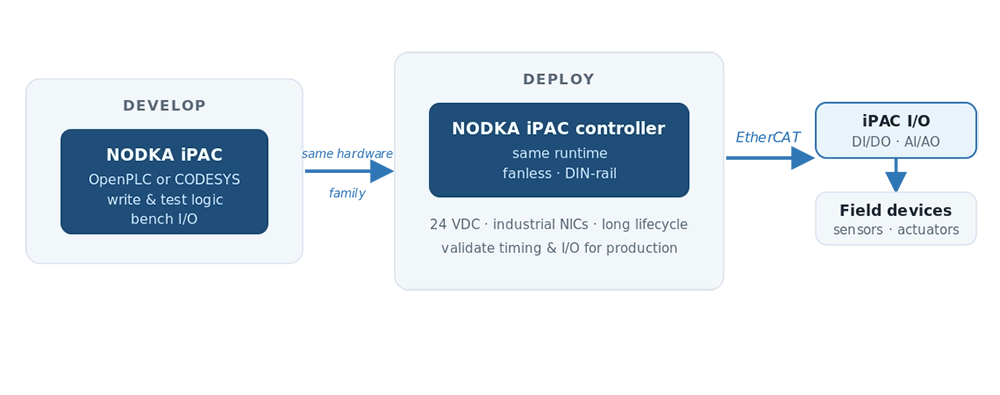
Figure 2. A common industrial PC platform can reduce or eliminate hardware migration between development and production. The final system still needs validation for timing, fieldbus compatibility, environmental requirements, and safety.
The useful feature for a soft PLC is runtime neutrality. Depending on operating-system support, licensing, drivers, and project requirements, the same industrial PC platform can be configured for OpenPLC or a commercial runtime such as CODESYS. The hardware provides a common mechanical, electrical, networking, and lifecycle baseline while each project selects and validates its control software.
Key takeaways
A soft PLC runs control logic as software on a general-purpose industrial computing platform instead of tying the runtime to one dedicated controller family.
OpenPLC and cloud-managed virtual PLC platforms such as Autonomy Edge are signals of a broader shift toward portable, versioned, and software-defined control.
Production readiness depends on the complete architecture: hardware, operating system, runtime, networking, I/O, safety, cybersecurity, and validation.
A fanless, DIN-rail industrial PC can provide a common hardware baseline from development through production while remaining open to different control runtimes.
Frequently asked questions
Can I use a Raspberry Pi as a PLC?
Yes, especially for learning, experimentation, and proof-of-concept work. For a production machine, evaluate power protection, thermal behavior, storage reliability, network interfaces, I/O protection, EMC, lifecycle, and serviceability, as well as the runtime’s real-time configuration.
Is OpenPLC suitable for industrial use?
OpenPLC can be used in industrial control architectures, but suitability is application-specific. Validate the runtime version, operating system, scan-time behavior, fieldbus configuration, cybersecurity, failure handling, and support model under the machine’s actual load and environment. Safety-related functions require an appropriately certified safety architecture.
What hardware runs OpenPLC?
OpenPLC runs on multiple hardware architectures, including Linux-based x86 and ARM systems. For production, an industrial PC typically adds protected power, industrial NICs, fanless thermal design, environmental ratings, DIN-rail mounting, and lifecycle controls. EtherCAT deployments also require a compatible, dedicated network interface and validated slave configuration.
What is the difference between a soft PLC and a traditional PLC?
A traditional PLC usually combines vendor-managed hardware, runtime, engineering tools, and I/O into one controller ecosystem. A soft PLC separates the runtime from the computing hardware, giving the system designer more freedom to choose the PC, operating system, I/O, and software stack.
Can the same industrial PC platform be used for OpenPLC or CODESYS?
Often, yes. A standard x86 or ARM industrial PC can support different runtimes when the operating system, processor architecture, licenses, drivers, and I/O stack are compatible. Each configuration should be treated as its own validated control-system build.
Does OpenPLC work with EtherCAT I/O?
At publication, OpenPLC Runtime v4 supports EtherCAT on Linux. The deployment requires a dedicated compatible NIC, the correct device-description files, suitable cycle-time settings, and validation of the exact coupler and I/O modules. EtherCAT support should therefore be confirmed at the full system level, not assumed from the connector alone.
Explore hardware for PC-based control
Build a runtime-neutral control platform around fanless, DIN-rail industrial hardware and modular field I/O.