

The data center build-out driving today’s power headlines is, overwhelmingly, AI infrastructure: training clusters, inference sites, and the “AI factories” that have more than tripled in capacity in about 18 months. Every one of those facilities runs on a layer of software most people never see: the SCADA and DCIM platform that watches power, cooling, and IT assets in real time. That software runs on hardware. This article breaks down the three-layer gateway architecture behind a modern data center SCADA system, and how to specify the edge gateway hardware that keeps it online.
Why AI is driving the data center monitoring boom
Data center electricity demand is on a near-vertical climb, and AI is the accelerant. The International Energy Agency projects global data center consumption could exceed 1,000 TWh in 2026 (roughly the total electricity use of Japan) and nearly double to about 945 TWh by 2030. In the United States alone, Goldman Sachs expects data center power demand to rise from about 31 GW in 2025 to 41 GW in 2026, and toward 95 GW by 2027, driven primarily by AI computer.
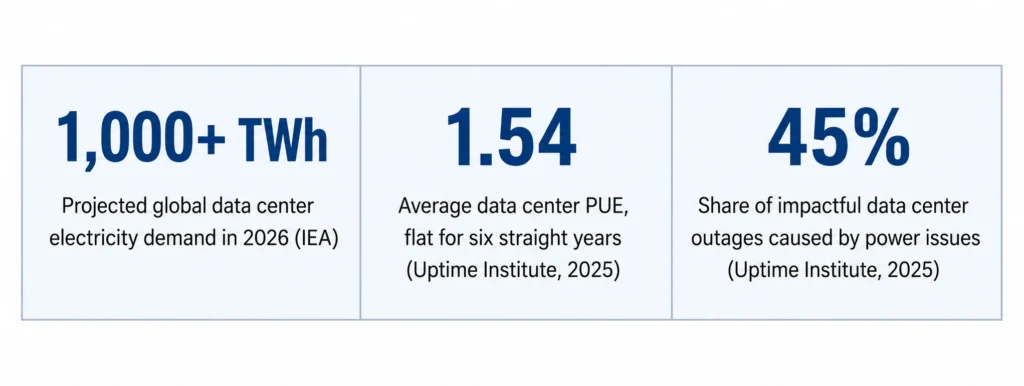
More load and far denser racks mean more electrical and mechanical infrastructure to monitor: switchgear, UPS systems, busway, power distribution units (PDUs), computer room air handlers (CRAC/CRAH), chillers, and building management systems (BMS). And because power remains the single largest cause of impactful outages, the monitoring system, and the hardware it runs on, is mission-critical infrastructure, not an afterthought.
What a data center SCADA system actually monitors
In data center terms, the supervisory platform usually spans three overlapping domains:
- EPMS (Electrical Power Monitoring System): medium- and low-voltage switchgear, UPS, generators, ATS/STS, PDUs, and branch circuit monitoring, often visualized as a live single-line diagram.
- BMS / mechanical monitoring: CRAC/CRAH units, chilled-water plants, pumps, temperature and humidity, and airflow, the cooling side that governs PUE (Power Usage Effectiveness).
- DCIM (Data Center Infrastructure Management): the unified layer that ties power, cooling, and IT-asset data together for capacity planning, alarming, and reporting.
Platforms like Ignition by Inductive Automation are widely used here because they are protocol-agnostic and license by server rather than per tag or per client, which matters when a single site can carry millions of tags. A public, award-winning reference makes the scale concrete: Vantage Data Centers runs an Ignition Perspective system across EMEA with 5.3 million-plus tags, roughly 21,000 devices (Modbus, BACnet, and PLCs), and 958 screens, built on exactly the layered gateway model described below.
The three-layer gateway architecture
A large data center SCADA deployment is almost never one server talking to everything. It is a distributed, redundant, scale-out architecture organized in three layers, each with a distinct job.
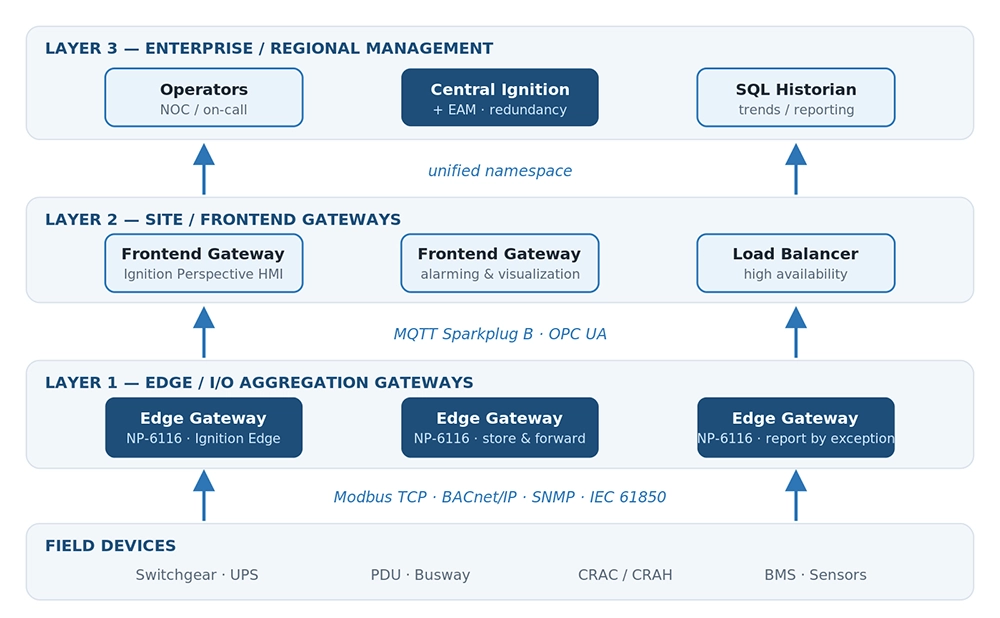
Layer 1: Edge / I/O aggregation gateways
This is the layer that touches the physical plant. Distributed edge gateways poll field devices over industrial protocols (Modbus TCP, BACnet/IP, SNMP, IEC 61850), normalize the data into User Defined Types (UDTs), and buffer it locally with store-and-forward so nothing is lost during a network interruption. Running Ignition Edge here, each gateway publishes clean, modeled data upward by exception. This is where an industrial automation computing platform becomes critical: NODKA’s Automation PC family is designed specifically for this Layer-1 edge role, not a repackaged office PC, but purpose-built industrial computing hardware.
Layer 2: Site / frontend gateways
Frontend gateways host the operator-facing HMI: Ignition Perspective single-line diagrams, BMS heat maps, alarm displays, and trends, often behind a load balancer for high availability. Operators interact here; they don’t talk directly to field devices.
Layer 3: Enterprise / regional management
The top layer consolidates multiple sites for the “big picture”: central historians, KPI/PUE roll-ups, and centralized deployment and version control across regions (Ignition’s Enterprise Administration Module, or EAM). At Vantage, this three-layer model (I/O gateways feeding frontend gateways feeding a regional management layer) cut development and commissioning cycles from months to weeks.
Why AI data centers raise the monitoring bar
An AI data center is not just a bigger conventional data center. It is thermally and electrically far more demanding, and that changes the monitoring requirement:- Extreme rack power density. Conventional racks often draw roughly 5–15 kW; accelerated-compute (GPU) racks can exceed 100 kW. Higher density means more power and thermal points to meter, and far less tolerance for a blind spot.
- Liquid and direct-to-chip cooling. Air alone can’t remove the heat, so AI halls add liquid loops, coolant distribution units (CDUs), leak detection, and tighter temperature/flow control, all of which need to be monitored in real time alongside the traditional BMS.
- Distributed inference at the edge. Inference is increasingly deployed in smaller, regional, and edge sites for low latency, which multiplies the number of facilities that each need their own reliable monitoring gateway.
Where NODKA fits — and where it doesn’t
The edge gateway monitors the facility infrastructure of an AI data center, including power, cooling, and BMS systems. It does not sit inside the GPU or compute racks. NODKA supplies the industrial monitoring hardware, while the AI compute and SCADA software are separate layers.
Where the edge gateway sits, and why it is the critical hardware choice
Follow a single data point, say a UPS load reading or a coolant temperature, from the plant to the dashboard, and the edge gateway is the first and most exposed piece of computing in the chain.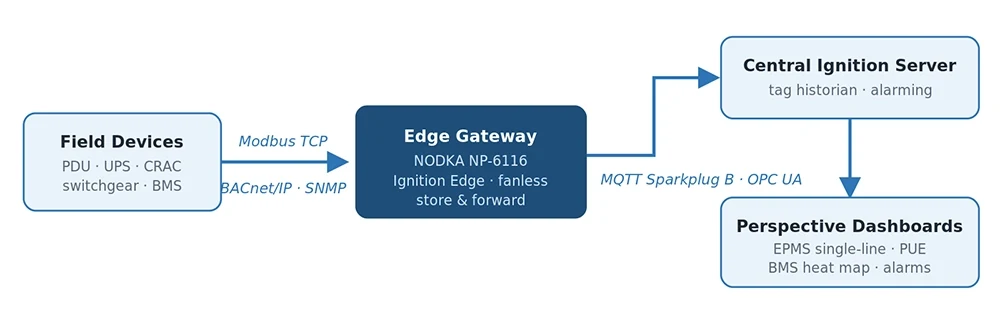 Because this node runs unattended, 24/7, in a mechanical yard, electrical room, or a hot containment aisle, the hardware underneath Ignition Edge is a reliability decision, not a commodity line item. An office-grade desktop or a mini-PC built for a conference room is the wrong tool: fans pull in dust and fail, consumer thermals throttle in warm rooms, and short product lifecycles wreck spares management across a multi-site fleet. The distinction is fundamental: an industrial automation computer is engineered for the plant floor from the start, not an office PC in a metal case.
Spec checklist for a data center edge gateway
- Fanless, no moving parts: no fan or spinning disk to fail or ingest dust.
- Multiple Gigabit Ethernet ports: physical separation of the OT device network from the IT/uplink network.
- Serial and digital I/O: RS-232/RS-485 and DI/DO for legacy meters, RTUs, and dry contacts.
- Wide-range DC input: 12–24 VDC for clean integration with panel power.
- DIN-rail or wall mount: fits inside the control panel, not a rack shelf.
- Long product lifecycle: a stable BOM you can standardize and stock across sites.