

How to Lock an Industrial PC BOM for 10+ Year Machine Lifecycles
Article Key Points:
- A controlled industrial PC BOM helps keep machine platforms stable over long product lifecycles.
- Hardware consistency supports reliable software performance across multiple installations.
- Stable core components like the CPU, chipset, motherboard, and BIOS reduce the need for repeated redesign and validation.
- Controlled management of parts such as RAM, SSDs, Ethernet, cooling, and power supplies helps maintain compatibility and serviceability.
- Long-lifecycle design strategies make it easier to support production, maintenance, and spare parts over many years.
- Modular approaches such as SoM design can simplify upgrades while preserving existing system wiring and interfaces.
Industrial machines are commonly designed to operate for ten to fifteen years, yet the computing hardware inside them evolves much faster. CPUs, chipsets, and storage devices may change every few years as semiconductor vendors introduce new generations or discontinue components.
In our previous article on Industrial PC Lifecycle vs Machine Lifespan, we discussed this lifecycle mismatch. For automation OEMs and machine builders, the practical challenge is maintaining hardware stability across multiple machine generations.
Why BOM Stability Matters for Machine Builders
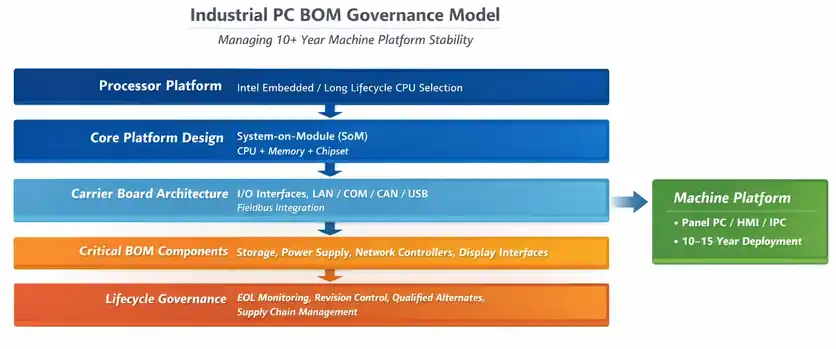
One effective strategy is locking the industrial PC bill of materials (BOM). A controlled BOM helps engineering teams maintain platform consistency, reduce repeated validation work, and deploy machines globally with predictable hardware behavior.
Automation OEMs typically standardize hardware platforms to maintain consistent machine performance and simplify long‑term service. When the industrial PC hardware changes unexpectedly, it can disrupt validated machine platforms.
| Objective | Why It Matters |
|---|---|
| Software stability | Ensures machine control software behaves consistently across installations |
| Spare part compatibility | Allows predictable service inventory for field machines |
| Reduced validation work | Prevents repeated engineering testing caused by hardware changes |
| Long-term production | Enables the same machine architecture to be produced for many years |
What Locking the BOM Means
Locking an industrial PC BOM does not mean every component must remain permanently unchanged. Instead, it means defining a controlled architecture where critical platform components remain stable while other parts are governed through approved substitutions.
Core Platform Layer
| Component | Role in Stability |
|---|---|
| CPU generation | Determines computing capability and long-term compatibility |
| Chipset platform | Defines system architecture and peripheral control |
| Industrial motherboard | Establishes I/O layout and system design |
| BIOS architecture | Maintains firmware compatibility |
Controlled System Components
| Component | Reason for Control |
|---|---|
| RAM modules | Platform timing and compatibility |
| SSD storage | Firmware behavior and reliability |
| Ethernet controllers | Driver and industrial protocol compatibility |
| Cooling solutions | Thermal performance and mechanical fit |
| Power supply | Electrical stability and standardized integration |
Peripheral Components
| Component | Characteristics |
|---|---|
| Cables | Easily replaceable with equivalent wiring |
| Mounting brackets | Mechanical parts with minimal system impact |
| Accessories | Non-critical additions such as adapters |
Industrial Motherboards and Platform Stability
The industrial motherboard defines the system architecture of an industrial PC platform. It determines CPU compatibility, I/O configuration, and firmware behavior.
Maintaining a stable motherboard platform allows machine builders to preserve system architecture even as replaceable components evolve. When the motherboard remains stable, software images and machine integrations can remain consistent across machine generations.
Using System‑on‑Module (SoM) Architectures
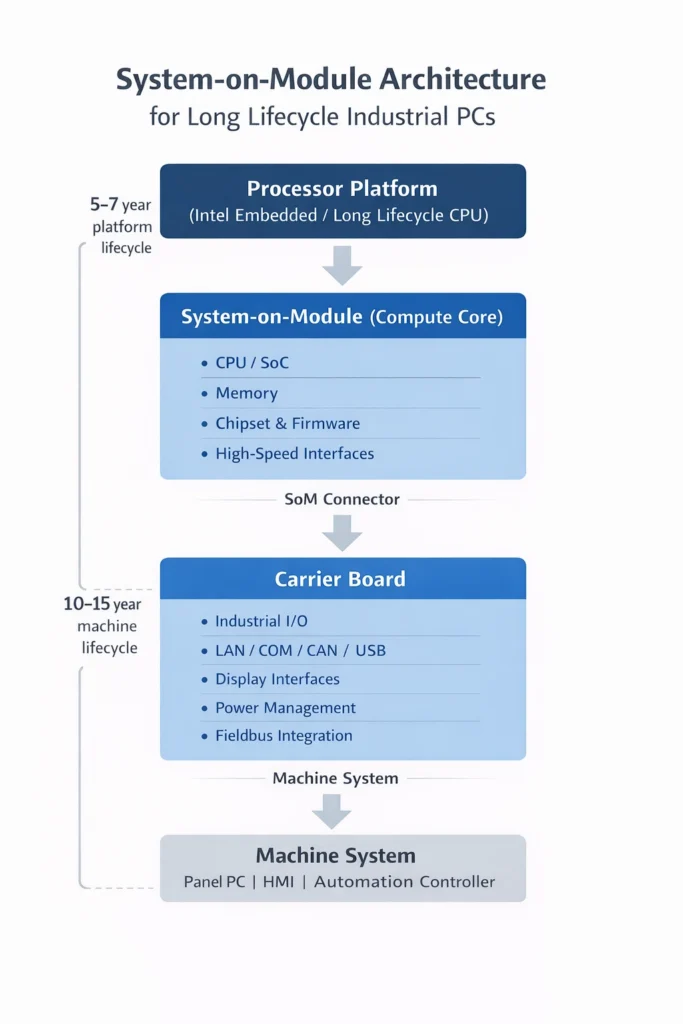
Another approach used in some industrial PC designs is a System‑on‑Module (SoM) architecture. In this model, the processor and core computing components are integrated into a modular compute module that connects to a carrier board.
This separation allows the I/O and mechanical design of the system to remain stable while the compute module can evolve when processor platforms change.
| SoM Design Benefit | Lifecycle Advantage |
|---|---|
| Modular compute platform | Enables processor upgrades without redesigning the full system |
| Stable carrier board I/O | Preserves machine wiring and interfaces |
| Reduced redesign effort | Limits engineering impact during platform transitions |
This modular approach is commonly used in panel PCs, HMIs, and automation PC controller platforms where long lifecycle machines must balance stability with evolving processor technology.
Five Steps to Lock an Industrial PC BOM
1. Select a Long Lifecycle Processor Platform
Processor selection is the foundation of BOM stability. Automation OEMs often choose processors designed for embedded or edge deployments because they offer longer lifecycle availability than consumer platforms. These processor families are designed for industrial systems expected to remain in production for many years.2. Freeze the Baseline Platform
Once validated, the motherboard platform, CPU generation, and BIOS configuration should remain stable for the machine platform.3. Establish an Approved Vendor List
Critical components such as memory and storage should be qualified through an approved vendor list to allow controlled substitutions when necessary.4. Implement Revision Governance
Hardware substitutions should follow defined engineering change procedures so updates are validated before deployment.5. Plan Platform Transitions
Even long lifecycle components eventually reach the end of life. Maintaining a roadmap for future platform updates reduces disruption when transitions occur.