
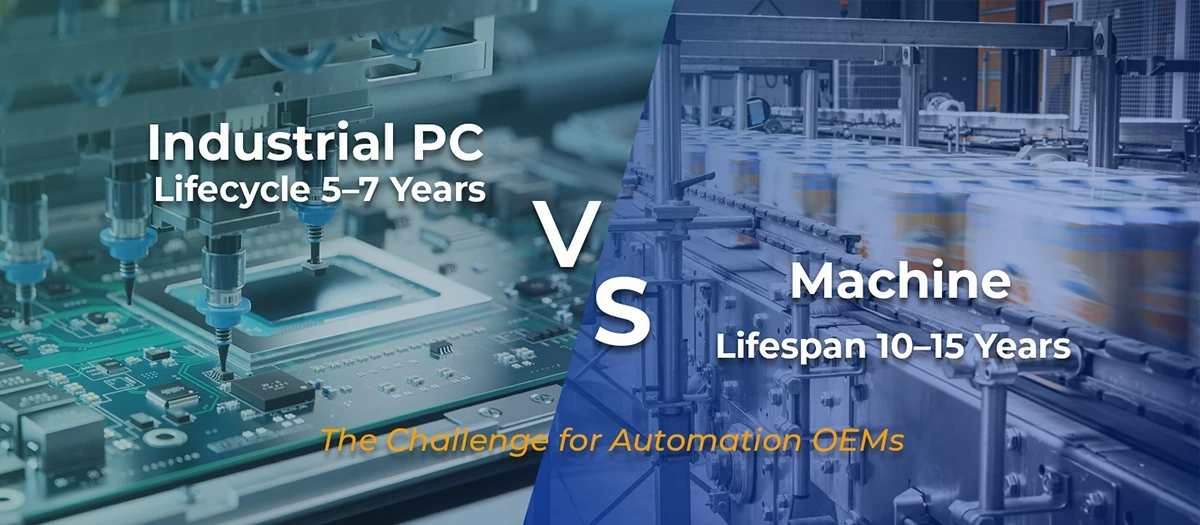

Industrial PC Lifecycle vs Machine Lifespan: The Challenge for Automation OEMs
Article Key Points:
- Industrial machines often last 10–15 years, while the PCs inside them usually do not.
- This lifecycle mismatch can create redesign, validation, and spare-parts challenges for automation OEMs.
- Because industrial PCs rely on faster-moving semiconductor platforms, hardware can reach end-of-life long before the machine does.
- OEMs reduce risk through platform standardization, BOM control, and lifecycle-aware hardware planning.
- The goal is not to avoid change, but to manage it in a stable, supportable way.
Industrial machines are often designed to operate for 10–15 years or more. Packaging lines, CNC platforms, robotic cells, and automated inspection systems are capital investments expected to remain productive across long equipment lifecycles.
However, the industrial computers embedded inside these machines, often installed inside machine controllers or control cabinets, follow a very different timeline. While machines are engineered for long operational lifespans, industrial PC platforms, and the industrial PC lifecycle itself,depend on semiconductor technology roadmaps that evolve much faster.
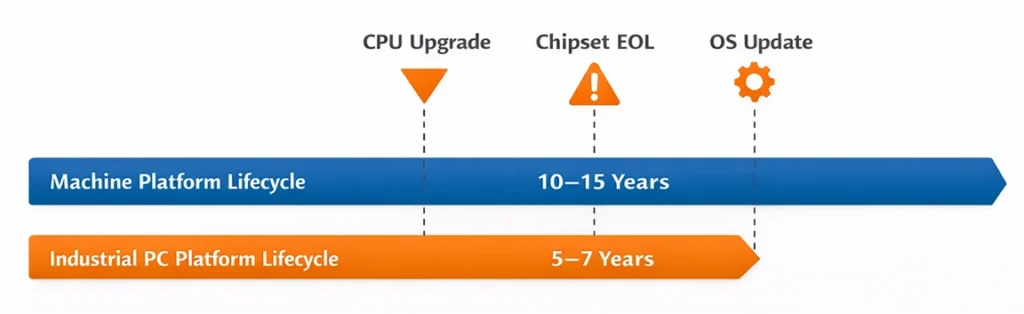
For automation OEMs, this creates a structural challenge: aligning long machine lifespans with shorter industrial PC platform lifecycles. The computing platform that controls a machine may reach the component end‑of‑life long before the equipment itself is retired.
This lifecycle mismatch is one of the most common but least discussed engineering challenges in modern industrial automation.
Understanding why these timelines diverge, and how automation companies manage the gap is the first step toward building automation systems that remain stable, serviceable, and supportable for a decade or longer.
Machine Lifespan vs Industrial PC Lifecycle
The difference between machine lifespan and computing platform lifecycle becomes clear when comparing typical timelines in industrial deployments.
| System | Typical Lifecycle |
|---|---|
| Packaging and assembly machines | 10–15 years |
| CNC machine tools | 15+ years |
| Vision inspection systems | 8–12 years |
| Industrial PC motherboard platforms | 5–7 years |
| CPU / chipset platform generations | 3–5 years |
Machines are expected to run for many years with minimal architectural change. Computing platforms, however, must evolve as semiconductor technologies advance and components reach the end‑of‑life.
For automation OEMs, aligning these two timelines becomes a critical system design consideration.
Machines Are Designed for Long Operational Lifespans
Automation equipment is rarely replaced every few years. Machine builders design systems with long service expectations because their customers invest heavily in production infrastructure.
Examples include:
- Packaging machines operating across multiple product generations
- CNC machine tools deployed for decades
- Vision inspection systems integrated into production lines
- Robotic workcells supporting continuous manufacturing
In many industries, machines remain in operation for 10–15 years with incremental upgrades rather than full replacements.
Customers therefore expect spare parts, software compatibility, and control hardware to remain available throughout that lifecycle.
Industrial PC Platforms Follow Semiconductor Lifecycles
Industrial PCs are built on semiconductor platforms that evolve far more quickly than industrial machines.
These platforms include CPUs, chipsets, network controllers, storage controllers, and other integrated components that follow semiconductor industry roadmaps.
Typical semiconductor platform transitions occur every few years as new CPU generations, chipset revisions, and peripheral controllers are introduced. When key components reach end-of-life (EOL), system platforms must transition to newer architectures.
Even industrial-grade motherboards designed for long availability ultimately depend on the lifecycle of these semiconductor components.
This dynamic means the industrial PC lifecycle typically experiences hardware transitions within a shorter window than the machines they support.
Where Lifecycle Mismatch Creates Real Engineering Risk
The mismatch between machine lifespan and industrial PC lifecycle does not always appear immediately. It often surfaces several years into production when hardware changes ripple through validated systems.
When the industrial PC lifecycle moves faster than the machine lifecycle, several engineering risks can appear.
Common risks include:
- Component end-of-life events forcing platform redesign
- Hardware revisions that affect validated operating system images
- Driver changes impacting real-time performance
- Certification revalidation requirements for regulated industries
- Difficulty maintaining identical spare parts for field service across long machine lifespans
For machine builders shipping equipment globally, these challenges can increase engineering overhead and service complexity.
Why Automation OEMs Often Absorb the Impact
Automation OEMs typically ship complete machines or integrated systems to customers. As a result, they are responsible for ensuring long-term reliability and serviceability.
When industrial PC platforms change, machine builders must evaluate the impact on software, system validation, and spare parts support.
The responsibility does not end at shipment. Field deployments must remain maintainable for years, particularly in industries where downtime is costly and machine replacements are infrequent.
This makes lifecycle planning an important engineering consideration during platform selection.
Aligning Industrial PC Platforms with Machine Lifespans
Because semiconductor technology evolves continuously, the goal is not to eliminate platform change but to manage it.
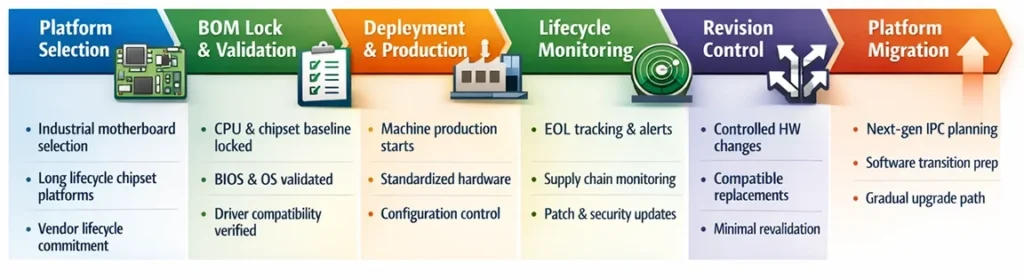
Automation OEMs increasingly address industrial PC lifecycle mismatch through several strategies:
Platform Standardization
Standardizing on a limited number of industrial PC platforms across product lines simplifies lifecycle management and reduces validation overhead. Many machine builders standardize one industrial PC platform across multiple machine models to simplify engineering validation, spare parts planning, and long-term service support.
Controlled BOM Governance
Managing approved component lists and change policies helps maintain hardware consistency across production runs.
Lifecycle-Aware Platform Design
Industrial computing vendors design motherboards and system platforms with long availability components and revision control strategies to support industrial deployments. Companies such as NODKA design industrial PC motherboards and embedded platforms with lifecycle-aware component selection, controlled revision management, and long-term availability planning to support machine builders shipping equipment worldwide. These approaches allow machine builders to maintain system stability while accommodating inevitable semiconductor transitions.
Lifecycle Planning Is Becoming a Strategic Requirement
As industrial systems become more software-driven and connected, the automation computer inside a machine becomes central to system architecture, making industrial PC lifecycle planning even more critical.
Industrial PCs now host motion control software, machine vision processing, data acquisition, and edge analytics workloads. This increased responsibility makes lifecycle planning even more important.
Automation OEMs that plan for lifecycle alignment early can reduce redesign cycles, protect validated software environments, and maintain predictable product support for customers.
From Lifecycle Awareness to Lifecycle Governance
Understanding the lifecycle mismatch between industrial PCs and machines is only the first step.
Many automation OEMs move beyond simply purchasing industrial PCs and adopt structured lifecycle governance strategies that include controlled platform transitions, BOM management, and collaborative development with industrial computing partners.
Conclusion
The lifecycle mismatch between industrial PCs and machine platforms is a natural result of semiconductor innovation cycles. Machines may operate for more than a decade, while computing platforms inevitably evolve as CPUs, chipsets, and controllers transition across generations.
For automation OEMs, the goal is not to avoid change but to manage it through careful platform selection, lifecycle planning, and controlled hardware governance. When these factors are considered early in system architecture, machine builders can maintain stable automation platforms while adapting to inevitable semiconductor transitions.
For automation OEMs seeking tighter lifecycle control, sourcing strategy becomes an important part of the equation. Understanding how industrial PC OEM and ODM programs influence lifecycle governance can help align computing platforms with long equipment lifespans.
Related Articles on Industrial PC Lifecycle Planning: